
The Challenge
3,000 miles of open ocean.
Alone.
The World’s Toughest Row is exactly what its name claims. Rowing it solo removes the one thing every crew relies on: someone else to take the oars. This is what Kimball is taking on.
The route
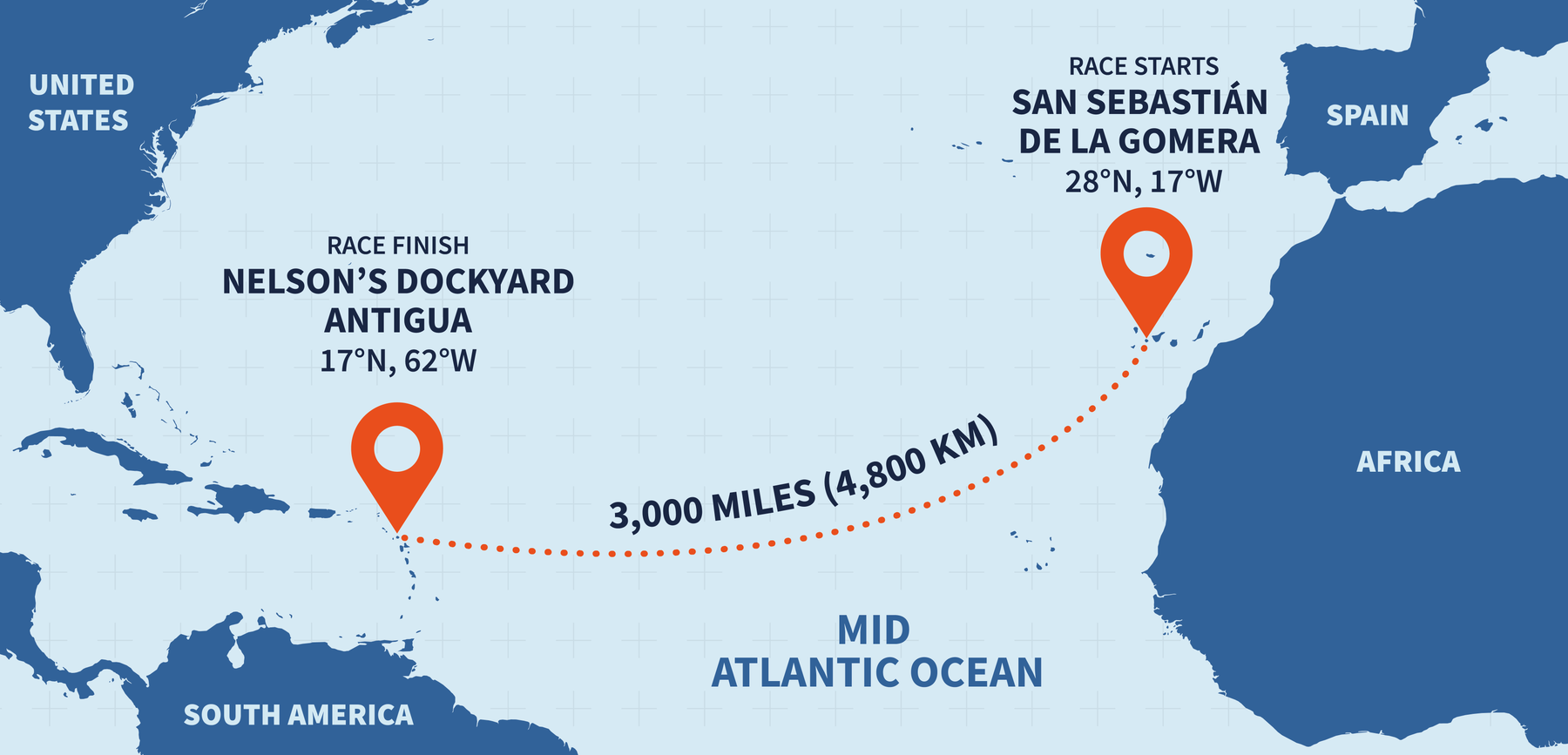
From the Canary Islands to Antigua.
Kimball will leave San Sebastián de La Gomera, the same port Columbus sailed from in 1492, and row west across the Atlantic to Nelson’s Dockyard in English Harbour, Antigua. The fleet departs each December into the winter trade winds.
- Start
- San Sebastián de La Gomera, Canary Islands
- Finish
- Nelson’s Dockyard, English Harbour, Antigua
- Distance
- 3,000 miles (4,800 km)
- Departs
- December 2029
- Average crossing
- 55 days
- At most
- 100 days
The human cost
What it takes out of a body.
Every figure here is from the race’s own reports. None of it is exaggerated. All of it is the everyday reality of a crossing.
- 1.5M oar strokes to cross the ocean
- 5,000+ calories burned per day
- 2 / 2 hours rowing, then hours sleeping, around the clock
- 12 kg average weight lost across the crossing Individual rowers lose between 3 and 18 kg (Physical & Mental Prep Guide p.5).
- 10 L of water made and drunk each day
- 20 ft waves the boat is built to survive
- 100 days alone at sea, at the very most The average crossing is 55 days; a solo rower plans 85 days of food.
- 8.5 km depth of the ocean beneath the hull
More people have climbed Everest than have rowed across the Atlantic.
Why solo is different
No one to share the oars.
In a team, rowers trade two-hour shifts, share decisions and keep each other moving. A solo rower does it all: navigation, repairs, cooking, sleeping, and the rowing itself, in the same relentless rhythm of roughly two hours on and two hours off, around the clock, for as long as the crossing takes.
The race organisers say 90% or more of rowing an ocean is the mental challenge. Solo, there is no crewmate to talk you through the dark hours. There is only the next stroke, and the discipline to take it.
Built for it
A small boat, engineered to survive a big ocean.
This is an extreme challenge, not a reckless one. Every boat that races has to be a proven self-righting design, with watertight cabins and a full redundant safety system on board.
Proven to self-right
Every design must be proven to roll back upright after a capsize, with watertight bulkheads and hatches.
Waves up to 20 feet
The hull is built to take the open Atlantic, the swell, the trade winds and the weather that comes with them.
Fresh water from salt
An onboard water maker turns seawater into the 10 litres a day a solo rower needs to keep going.
For context
The company he intends to keep.
30d 7h 49m
fastest solo Atlantic crossing in history (Mark Slats, 2017)
18
age of the youngest person to row the Atlantic solo (2018)
55 days
the average crossing, though it can take up to 100
The whole point
You do not cross an ocean. You take one stroke, 1.5 million times, and the ocean passes beneath you.
Two ways aboard
Back the campaign and put your brand on the boat, or simply follow the journey across the Atlantic. Every step counts.